
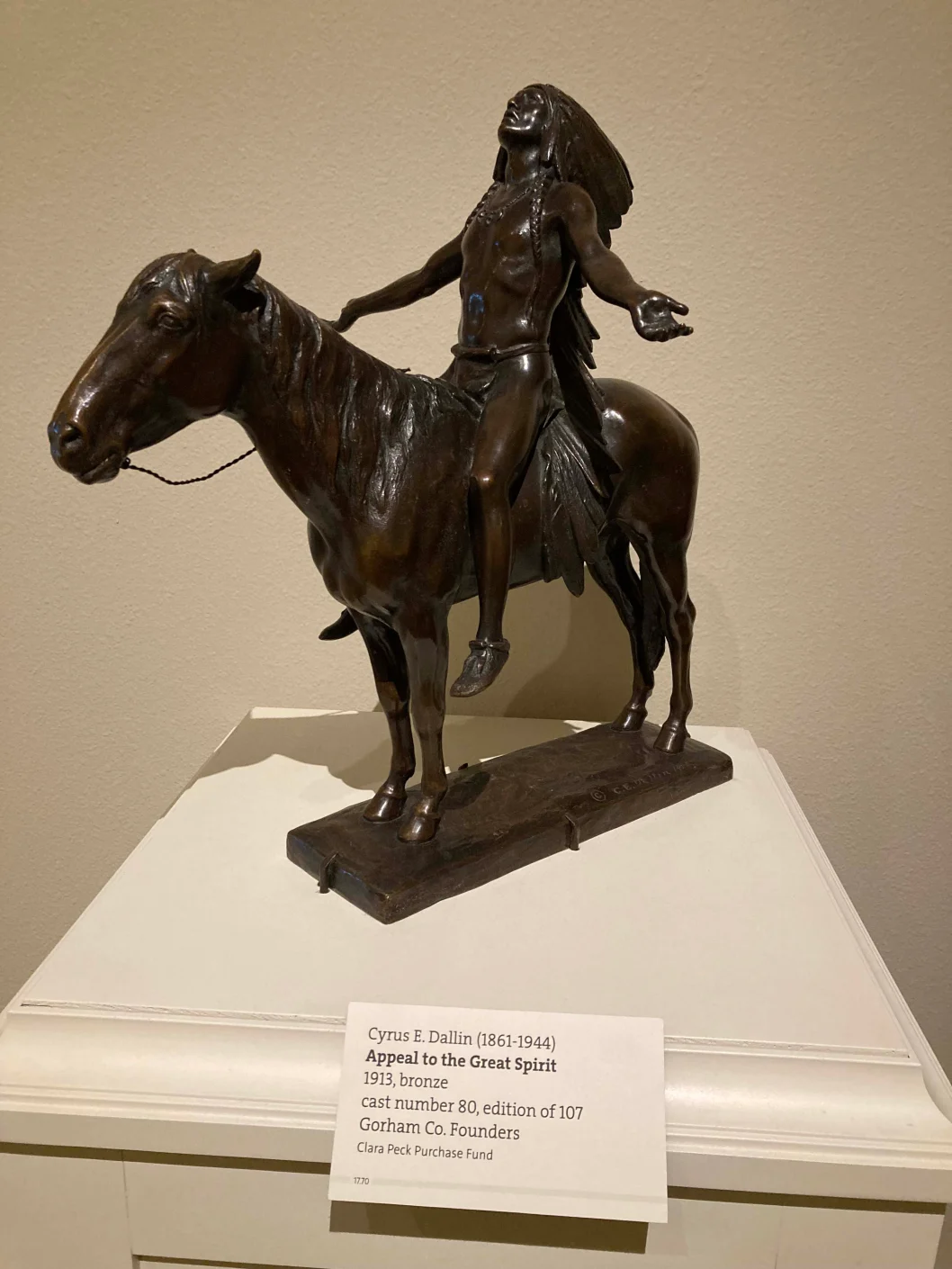
Above photo comes from blog, Camper Chronicles. It shows a small-scale replica in Whitney Western Art Museum (Cody, Wyoming, near Yellowstone National Park) of larger-than-life statue found outside Boston Museum of Fine Arts. The artist was Cyrus Dallin, born in Utah, who sculpted some 260 works of various figures. Dallin was a member of Unitarian church.
Men and women are spiritual creatures. Homo sapiens is religious by nature. Within us is a power that points to the sky, to a greater power.1
This next photo also comes from Camper Chronicles.

Jesus of Nazareth was an itinerant preacher and healer in his native land many centuries ago. Some of his sayings bear on this aspect of his mission and on the basic need of men/women to move.
Foxes have holes, and birds have nests, but the Son of Man has no place to lie down and rest (Mt 8:20 GNB)
If one walks in the day he does not stumble . . . however if one walks in the night he stumbles (Jn 11:9f)
Become like passersby (GTh 42)
Is man searching for safety and ultimately, paradise?
Two Thoughts from Books
“.. the mystical needs of human beings are so urgent that they will seek their satisfaction wherever it may be found.”2
The Hobbit, Tolkien’s first published work of fantasy, bears a strong resemblance to the fairy tale, particularly in its structure, its interest in the idea of heroism, and its attention to the opposition between good and evil. Structurally, The Hobbit is neat and tidy, almost elegant. As its subtitle, “There and Back Again,” suggests, the underlying metaphor is the journey …3
Footnotes
- “Men and women started to worship gods as soon as they became recognizably human; they created religions at the same time as they created works of art. This was not simply because they wanted to propitiate powerful forces, these early faiths expressed the wonder and mystery that seem always to have been an essential component of the human experience …” Karen Armstrong, A History of God (NY: Ballantine, 1994), p xix
- Geoffrey Parrinder, Mysticism in the World’s Religions (NY: Oxford, 1976), p 195
- Katharyn Crabbe, J.R.R. Tolkien (NY: Continuum, 1988), p 34


 Paul's Place for Writing