
Sources
Gospels of John, Mark, Luke, Matthew
Acts of the Apostles
Josephus, Antiquities of the Jews
Life
According to Luke, John was son to Elizabeth and Zechariah; Zechariah a priest of the order of Abijah, in a line descended from Aaron, Moses’ brother (Lk 1:5; 1 Chron 24:1-19). Luke reports an angelic visitation to Zechariah while on duty in the Temple, announcing the birth of John. Said Gabriel,
he will be great in the sight of the Lord. He is never to take wine or other fermented drink, and he will be filled with the Holy Spirit even before he is born. He will bring back many of the people of Israel to the Lord their God. (Lk 1:15f)
As son in a priestly family, John was trained in the Law of Moses, particularly the ‘Holiness Code’ (Lev 17:1-27:34). Note that this section of Leviticus, ‘Holiness Code,’ contains the provision, ” You shall not uncover the nakedness of your brother’s wife” (Lev 18:16). According to Mark, John the Baptist was executed by Herod Antipas because John had told Herod, “It is not lawful for you to have your brother’s wife” (Mk 6:18).
Apparently, John was an only child,1 and would be expected to enter priesthood, but our sources do not identify John as priest, rather as preacher and prophet. The angel Gabriel’s words to Zechariah above do explain this departure from the hereditary norm among priestly families in Israel. God had a special mission for John. Luke states, “The child grew and became strong in spirit. He lived in the wilderness until the day he appeared publicly to Israel” (Lk 1:80). Presumably, John was at least thirteen years of age before leaving home for the wilderness, and may have been entrusted to Essenes living in the Judean desert to continue his training.2 John the Baptist was about thirty years old at start of his ministry, since Luke indicates this was the fifteenth year of Tiberius Caesar, that is, 28 A.D., and when John baptized Jesus of Nazareth, Jesus “was about thirty years old,” these two having been born within nine months of each other (Lk chap. 3).
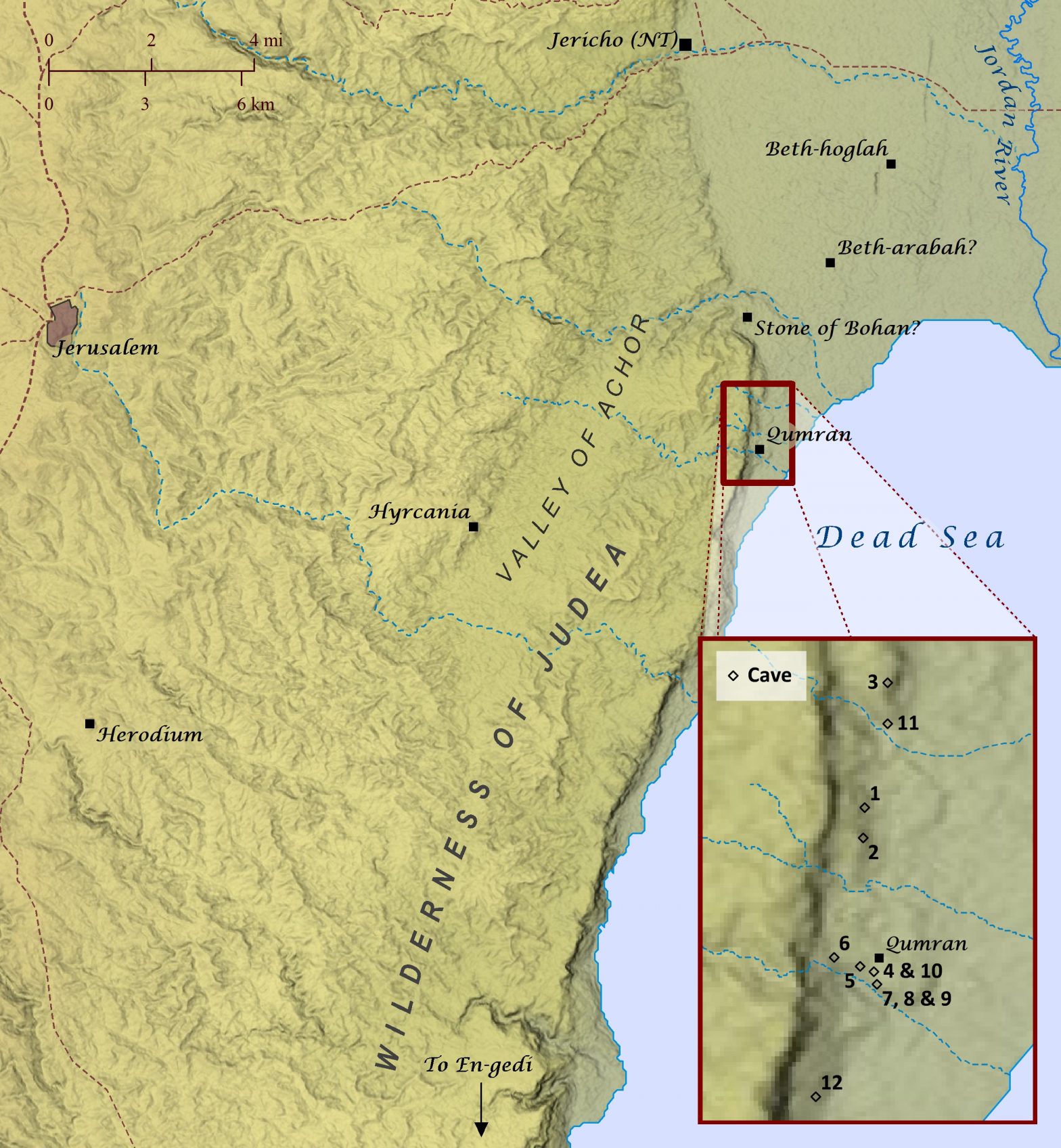
Wilderness (Greek noun: erémia) or desert is a significant term in the life and mission of John the Baptist. “All four gospels locate John in the wilderness and associate his appearance in that location with a prophecy from the Jewish Scriptures: ‘A voice cries out: In the wilderness make ready the way of the Lord, make straight in the desert a highway for our God’ (Isa 40:3).”3 The poetic prophecy of Isaiah, chapter forty, tells of a future reckoning, when,
Every valley shall be raised up,
every mountain and hill made low;
the rough ground shall become level,
the rugged places a plain.
And the glory of the Lord will be revealed,
and all people will see it together.
For the mouth of the Lord has spoken. (Isa 40:4f)
To continue with Isaiah 40,
A voice says, “Cry out.”
And I said, “What shall I cry?”
“All people are like grass,
and all their faithfulness is like the flowers of the field.
The grass withers and the flowers fall,
because the breath of the Lord blows on them.
Surely the people are grass.
The grass withers and the flowers fall,
but the word of our God endures forever.” (vv. 6ff NIV)
This passage and others4 may be considered as background to John’s message.
People encounter God in the desert. Hagar, mother of Ishmael, twice was rescued by the Lord in the desert (Gen 16:1-15; 21:9-21); Moses found God on Mount Horeb [Sinai] in a burning bush (Ex 3:1-14); Elijah, running from Queen Jezebel, escaped to the wilderness and Mount Horeb and met YHWH (1 Kings 19:1-14). Entry into the wilderness in a lifestyle change involves exiting civilization, renunciation of material things, extras not needed, rejection of marriage and family and the concerns that go along with such. Life in the desert is an askesis, letting what is unneeded fall away to focus on God. This was the case for John. So we read that John the Baptist “was clothed with camel’s hair, with a leather belt around his waist, and he ate locusts and wild honey” (Mt 3:4; Mk 1:6). Food, clothing and shelter5 were the only worldly things he bothered about, although we admit there is much unknown in the life of John the Baptist.
First century historian, Josephus, and Mark agree that John the Baptist died by execution, by order of Herod Antipas, tetrarch of Galilee and Perea. Here is Mark’s account.
Herod was the one who had John arrested and bound in prison on account of Herodias, the wife of his brother Philip, whom he had married. John had said to Herod, “It is not lawful for you to have your brother’s wife.” Herodias harbored a grudge against him and wanted to kill him but was unable to do so. Herod feared John, knowing him to be a righteous and holy man, and kept him in custody. When he heard him speak he was very much perplexed, yet he liked to listen to him. She had an opportunity one day when Herod, on his birthday, gave a banquet for his courtiers, his military officers, and the leading men of Galilee. Herodias’s own daughter came in and performed a dance that delighted Herod and his guests. The king said to the girl, “Ask of me whatever you wish and I will grant it to you.” He even swore [many things] to her, “I will grant you whatever you ask of me, even to half of my kingdom.” She went out and said to her mother, “What shall I ask for?” She replied, “The head of John the Baptist.” The girl hurried back to the king’s presence and made her request, “I want you to give me at once on a platter the head of John the Baptist.” The king was deeply distressed, but because of his oaths and the guests he did not wish to break his word to her. So he promptly dispatched an executioner with orders to bring back his head. He went off and beheaded him in the prison. He brought in the head on a platter and gave it to the girl. The girl in turn gave it to her mother. When his disciples heard about it, they came and took his body and laid it in a tomb. (Mark 6:17-29 NABRE)
Josephus wrote of John the Baptist in context of discussing Herod’s dispute with King Aretas IV of Nabataea, who was father to Herod’s first wife, Phasa’el. She had heard of Herod’s plan to divorce her for his brother’s wife, Herodias, and complained to her father, who made war against Herod and defeated Herod’s army. Here is what Josephus says of John the Baptist.
But to some of the Jews the destruction of Herod’s army seemed to be divine vengeance, and certainly a just vengeance, for his treatment of John, surnamed the Baptist. For Herod had put him to death, though he was a good man and had exhorted the Jews to lead righteous lives, to practice justice towards their fellows and piety towards God, and so doing to join in baptism. In his view this was a necessary preliminary if baptism was to be acceptable to God. They must not employ it to gain pardon for whatever sins they committed, but as a consecration of the body implying that the soul was already thoroughly cleansed by right behaviour. When others too joined the crowds about him, because they were aroused to the highest degree by his sermons, Herod became alarmed. Eloquence that had so great an effect on mankind might lead to some form of sedition, for it looked as if they would be guided by John in everything that they did. Herod decided therefore that it would be much better to strike first and be rid of him before his work led to an uprising, than to wait for an upheaval, get involved in a difficult situation and see his mistake. Though John, because of Herod’s suspicions, was brought in chains to Machaerus, the stronghold we have previously mentioned, and there put to death, yet the verdict of the Jews was that the destruction visited upon Herod’s army was a vindication of John, since God saw fit to inflict such a blow on Herod.6
John’s oratory on proper relations to God and among men led to his imprisonment and death.
Message
In New Testament times, the Jordan River flowed from Lake Hula7 (or Huleh) and Hula Valley in northern Galilee south to Sea of Galilee and continued south through the wide Jordan Valley for some sixty-five miles to the Sea of Salt (Dead Sea). The actual length of the Jordan, because of its “serpentine turns,” is “about 320 km. (200 mi.).”8 John baptized people in lower course (i.e., between Sea of Galilee and Salt Sea) of the Jordan, in the river itself or in adjacent pools or springs (such as “Aenon,” Jn 3:23). Baptism and preaching are the two actions of John’s ministry to Israel by which he tried to turn the nation back to God and prepare whoever came to him for the apocalypse, that “great and dreadful day of the Lord” (Joel 2:1, 11, 31). Two sites on the Jordan River today are claimed as places where John baptized, Al-Maghtas and Hajlah Ford.

John the Baptist, “a righteous and holy man,” according to Mark (see above), “a good man,” according to Josephus (above), affected and aroused people by his powerful public speaking. He said,
Repent, for the kingdom of heaven is coming close (Mt 3:2),
and John’s word was heard and received by many of his countrymen. “It was as though a spark had fallen on dry tinder.”9 Living souls were needful and ready to accept John the Baptist’s prophetic message of God finally revealing His might in ending injustice and evil in their world.
Political Background
In fourth century before Christ, Alexander the Great, son of Philip II, king of Macedonia; a pupil of Aristotle, Greek philosopher; conquered the Near East from Egypt to India. Alexander died in 323 B.C. and his Hellenic Empire was split among his generals, the diadochoi (successors). Judea came under control of Ptolemy and his heirs in Egypt until circa 200 B.C., when the Seleucid Empire, under Antiochus III, wrested control of south Syria and Palestine from Ptolemy V. For over a hundred-fifty years, Hellenistic culture seeped into the Jewish homeland, just as previously, Babylonian and Persian influence had been felt there. The entrance and spread of Greek ideas and practices resulted in social conflict among the people of Israel in second century B.C., as recorded in First Book of Maccabees, when “a sinful offshoot, Antiochus Epiphanes” … “became king” (I Macc 1:10).
Antiochus IV Epiphanes, a son of Antiochus III, ruled Seleucid Empire from 175 to 164 B.C., and, contrary to previous Seleucid policy allowing native religious and social custom to continue, interposed his own control of Judean religion by making high priest whoever paid him the most money.10 Antiochus IV plundered the Temple on Mount Zion, by military might forced Jews to abandon sacred law in favor of Greek worship and ritual, and in 167 B.C., “the king erected the desolating abomination upon the altar of burnt offerings, and in the surrounding cities of Judah they built pagan altars” (I Macc 1:54). Those who didn’t conform to Greek mores and behavior, for example, by continuing to practice circumcision or read scrolls of the law (Moses), were killed.
Excerpt from I Maccabees on the persecutions:
Any scrolls of the law that they found they tore up and burned.
Whoever was found with a scroll of the covenant, and whoever observed the law, was condemned to death by royal decree.
So they used their power against Israel, against those who were caught, each month, in the cities.
On the twenty-fifth day of each month they sacrificed on the pagan altar that was over the altar of burnt offerings.
In keeping with the decree, they put to death women who had their children circumcised,
and they hung their babies from their necks; their families also and those who had circumcised them were killed.
But many in Israel were determined and resolved in their hearts not to eat anything unclean;
they preferred to die rather than to be defiled with food or to profane the holy covenant; and they did die.
And very great wrath came upon Israel. (I Macc 1:56-64)
This hostile situation led to the uprising of Mattathias, a priest, and his sons, collectively called ‘the Maccabees’ (Hebrew, ‘hammers’) in 168-164 B.C. The Maccabees and their followers, including specially pious adherents of the law of Moses (‘Hasideans,’ see I Macc 2:42), fled their homes for the hills of the Judean desert, conducting warfare against Syrian/Greek forces and their Jewish collaborators in the land. The Maccabees won many battles and succeeded in overthrowing foreign dominion. Victory of the Maccabean Revolt resulted in purification and rededication of the Temple.11
The Maccabees and their descendants ruled Israel until 37 B.C., when Herod the Great “reconquered Jerusalem”12 with help from Rome. Roman general Pompey had captured Palestine in 63 B.C. The last heir of the Maccabees to govern was Mattathias Antigonus (40-37 B.C.), who was executed by Rome, by Mark Antony.
The Maccabees wielded political power over Israel, by virtue of their military might, and spiritual power, by attaining the office of High Priest. The first Maccabee to hold High Priestly status was Jonathan (c. 153-143 B.C.), one of the five sons of Mattathias (originator of the Maccabean Revolution), who was granted this high-holy station by king of Syria, Alexander Balas. Thus began the Hasmonean Dynasty (Hasmon was family/ancestral name of Mattathias) in Israel; High Priests holding political and military authority, which was confirmed, circa 141 B.C., by decision of “the Jewish people and their priests” (I Macc 14:41ff), when Simon, Jonathan’s brother, had succeeded to the sacred post.13
It is clear that the Pharisees and the Essenes, major sects of Second Temple Judaism (c. 515 B.C. – 70 A.D.), emerged during the Hasmonean Dynasty, though their origins are murky, many historical details unknown. The Sadducees, another major sect, also were present in the Hasmonean Era. All are discussed at various points in the writings of historian Josephus.14 These sects or schools or parties were rivals for leadership in guiding Jewish life, including counsel to the Hasmonean rulers. The things that were important to them in formulating their teachings were God and covenant, Temple and its rites, role and functions of High Priest, governance of the nation, sacred writings (Torah, Prophets), calendar (for proper determination of holy days). Through the one-hundred-twenty or so years of the Maccabee/Hasmonean family Dynasty, one or the other group was in favor. The Essenes departed the Jerusalem political scene, preferring exile over wickedness they saw in the capital city.
Essene Background
Pharisees, Sadducees, Essenes, each had disputes with the Hasmonean rulers at various times, but it is the Essenes who are most relevant in establishing background for John the Baptist. Like John the Baptist, Essenes lived in the Judean desert.15
And when these become members of the Community in Israel according to all these rules, they shall separate from the habitation of ungodly men and shall go into the wilderness to prepare the way of Him..16
As John’s disciples were leaving, Jesus began to speak to the crowd about John: “What did you go out into the wilderness to see? A reed swayed by the wind? If not, what did you go out to see? A man dressed in fine clothes? No, those who wear fine clothes are in kings’ palaces. Then what did you go out to see? A prophet? Yes, I tell you, and more than a prophet. This is the one about whom it is written:”
‘I will send my messenger ahead of you,
who will prepare your way before you.’ (Matt 11:7-10)
Both, Essenes and John the Baptist, knew how to survive in the desert (access to potable water is crucial), and both lived there for religious reasons (purification from worldly evils, prophecy).
Two main areas of life and thought shared by the Essenes and John the Baptist are fundamental concern for moral matters and an apocalyptic view of the future. Both themes are expressed in first sentence of The Damascus Rule (c. 100 B.C.), a foundational text of Essene teaching.
Hear now, all you who know righteousness, and consider the works of God; for He has a dispute with all flesh and will condemn all those who despise Him.17
Essenes considered their group a “remnant to Israel” and God “did not deliver it up to be destroyed” (CD 1:2). “They perceived their iniquity and recognized that they were guilty men” (CD 1:2) and God “raised for them a Teacher of Righteousness to guide them in the way of His heart” (CD 1:3). The “wicked” are “those who depart from the way and abhor the Precept” (CD 2:1,2). “Satan shall be unleashed against Israel, as He spoke by the hand of Isaiah, son of Amoz, saying, ‘Terror and the pit and the snare are upon you, O inhabitant of the land’ (Isa 24:17). Interpreted, these are the three nets of Satan with which Levi son of Jacob said that he catches Israel by setting them up as three kinds of righteousness. The first is fornication, the second is riches, and the third is profanation of the Temple. Whoever escapes the first is caught in the second, and whoever saves himself from the second is caught in the third (Isa 2:18)” (CD 3:7 or Vermes translation ch. IV). Damascus Rule goes on to promulgate rules or statutes for Essene members. The same or similar rules are given in another Essene writing, The Manual of Discipline or The Community Rule (c. 100 B.C.). Here is its first sentence,
[The Master shall teach the sai]nts to live [according to] the Book of the Community Rule, that they may seek God with a whole heart and soul, and do what is good and right before Him as he commanded by the hand of Moses and all His servants the Prophets; that they may love all that He has chosen and hate all that He has rejected; that they may abstain from all evil and hold fast to all good; that they may practice truth, righteousness, and justice upon earth and no longer stubbornly follow a sinful heart and lustful eyes committing all manner of evil.18
Here are a few rules specified for judgment in a “Community Inquiry” –
“If one of them has lied deliberately in matters of property, he shall be excluded from the pure meal of the Congregation for one year and shall do penance with respect to one quarter of his food” (1QS 5:1, in Vermes trans., ch. VI) [“1Q” refers to cave 1 where the scroll was discovered in the Qumran area and “S” is for Hebrew term ‘sarekh’ meaning rule].
“If any man has uttered the [most] Venerable Name even though frivolously, or as a result of shock or for any other reason whatever, while reading the Book or praying, he shall be dismissed and shall return to the Council of the Community no more” (1QS 5:3, in Vermes, ch. VII [p. 70f]).
“Whoever has lain down to sleep during an Assembly of the Congregation: thirty days” (1QS 5:12; in Vermes, ch. VII [p.71])
“Whoever has spat in an Assembly of the Congregation shall do penance for thirty days” (1QS 5:14; Vermes, VII [p.71])
Here is a rule “which the men of perfect holiness shall follow in their commerce with one another” – “As for the property of the men of holiness who walk in perfection, it shall not be merged with that of the men of falsehood who have not purified their life by separating themselves from iniquity and walking in the way of perfection. They shall depart from none of the counsels of the Law to walk in the stubbornness of their hearts, but shall be ruled by the primitive precepts in which the men of the Community were first instructed until there shall come the Prophet and the Messiahs of Aaron and Israel” (1QS 7a, 3; in Vermes, chs. VIII, IX [p. 73f]).
Messianic expectation and anticipation of the end-times were high among the Essenes, as we find eschatological teaching in many of the scrolls discovered near the Dead Sea. Some Essenes hoped for two messiahs, as in the text cited above, a priestly messiah (“Aaron”) and a political messiah (“Israel”), a division of power that points to the sect’s origin as a protest movement against Hasmonean takeover of both high-priestly function and government rule.19 Another Qumran text mentions a single messiah, who
“will heal the wounded, and revive the dead and bring good news to the poor.”20
The Gospels of Matthew and Luke have similar phrasing in Jesus’ response to disciples of John the Baptist, who were sent by John (while in prison) to ask the Nazarene prophet, “Are you the one who is to come, or shall we look for another?” (Mt 11:3) Said Jesus,
“Go back and report to John what you have seen and heard: The blind receive sight, the lame walk, those who have leprosy are cleansed, the deaf hear, the dead are raised, and the good news is proclaimed to the poor. (Lk 7:22)
Twofold Message of John the Baptist
As in Essene background above sketched, John the Baptist’s preaching has two large themes, (1) imminence of apocalypse, (2) repentance.
Apocalypse
The end is near, it is coming (Greek verb, eggizó), said the Baptist, as in Matthew 3, verse 2,
Repent–for the kingdom of heaven is fast approaching.21
Also said John (to “Pharisees and Sadducees” in Matthew or “the multitudes” in Luke),
Brood of vipers! Who warned you to flee from the wrath to come? (Lk 3:7//Mt 3:7)
All mankind is naturally ‘brood of vipers’ (see, Gen 3:1-7) without repentance. The ‘wrath to come’ is the Creator’s execution of judgment and punishment upon disobedient humanity (see, Hab 2:2-5).
John the Baptist was asked, “who are you?” He replied,
I am the voice of one crying out in the wilderness,
‘Make straight the way of the Lord’ (Jn 1:22f)22
The Baptist was readying people for apocalypse, the coming of the Lord almighty. Part of his mission was to recognize and reveal a ‘coming one’ who would accomplish God’s purpose.
I am baptizing you with water, for repentance, but the one who is coming after me is mightier than I. I am not worthy to carry his sandals. He will baptize you with the holy Spirit and fire. His winnowing fan is in his hand. He will clear his threshing floor and gather his wheat into his barn, but the chaff he will burn with unquenchable fire. (Matt 3:11f; also Lk 3:16f)
After me goes a man who comes to be in front of me, because he was to be ahead of me. (Jn 1:30)23
This coming and going one, John the Baptist identified with Jesus of Nazareth, whom he called “lamb of God, who takes away the sin of the world,” an extension of John’s own mission to purify Israel.24 This ‘lamb of God’ oracle presents an insight of John the Baptist based on mystical experience of Jesus’ baptism, retold in all four gospels.25
Repentance
Repentance is psycho-spiritual turning from evil and sin to the good. Repentance is an interior realization and change of heart and mind resulting in behavioral reform. John the Baptist preached repentance, as seen in gospel passages cited above. His message bears repeating,
Repent, for the kingdom of heaven is at hand (Mt 3:2),
and was repeated often by Jesus of Nazareth,
“The time has come,” he said. “The kingdom of God has come near. Repent and believe the good news!” (Mk 1:15)
This recurrence between John the Baptist and Jesus shows alignment in mission of these two and importance of repentance.
Said John the Baptist “to the crowds who came out to be baptized by him,
You brood of vipers! Who warned you to flee from the coming wrath? Produce good fruits as evidence of your repentance; and do not begin to say to yourselves, ‘We have Abraham as our father,’ for I tell you, God can raise up children to Abraham from these stones. Even now the ax lies at the root of the trees. Therefore every tree that does not produce good fruit will be cut down and thrown into the fire.” (Lk 3:7-9 NAB)
Isn’t John’s message clear? It’s akin to words from the ‘Song of Moses:’
‘See now that I, even I, am he,
and there is no god beside me;
I kill and I make alive;
I wound and I heal;
and there is none that can deliver out of my hand.
For I lift up my hand to heaven
and swear, As I live forever,
if I sharpen my flashing sword
and my hand takes hold on judgment,
I will take vengeance on my adversaries
and will repay those who hate me. (Deut 32:39-41)
Some examples of correct conduct from John the Baptist:
“What should we do then?” the crowd asked. John answered, “Anyone who has two shirts should share with the one who has none, and anyone who has food should do the same.” Even tax collectors came to be baptized. “Teacher,” they asked, “what should we do?” “Don’t collect any more than you are required to,” he told them. Then some soldiers asked him, “And what should we do?”He replied, “Don’t extort money and don’t accuse people falsely—be content with your pay.” (Lk 3:10-14 NIV)
Not all disciples of John the Baptist became followers of Jesus of Nazareth, as shown by their questioning of Jesus and Jesus’ response,
And blessed is anyone who takes no offense at me. (Lk 7:23)
The Baptist movement spread around Asia and into the East. St. Paul encountered followers of the Baptist at Ephesus and converted twelve of them.
And he said unto them, Unto what then were ye baptized? And they said, Unto John’s baptism.Then said Paul, John verily baptized with the baptism of repentance, saying unto the people, that they should believe on him which should come after him, that is, on Christ Jesus. When they heard this, they were baptized in the name of the Lord Jesus. (Acts 19:3-5 KJV)
Mandaean religion, still practiced in parts of Iraq and Iran, preserves teachings of John the Baptist, holding him in high regard.26 Said the Nazarene of John the Baptist,
Amen I say to you, there has not arisen among those born of women, one greater than John the Baptist.(Mt 11:11)

[Bouts created a similar painting of John the Baptist some five years later.]
Notes
- Implied by Elizabeth’s words at Luke 1:25, “The Lord has done this for me. In these days he has shown his favor and taken away my disgrace among the people.”
- Thirteen is the age of religious maturity for Jewish males, viz., bar mitzvah. The Essene sect produced the Dead Sea Scrolls and had been dwelling in the desert since their Teacher of Righteousness fled Jerusalem in second century B.C. See, Geza Vermes, An Introduction to the Complete Dead Sea Scrolls (Minneapolis: Fortress Press, 2000), pp. 132-137; also, Jodi Magness, The Archaeology of Qumran and the Dead Sea Scrolls (Grand Rapids: Eerdmans, 2002), pp. 63-69
- Catherine Murphy, John the Baptist: Prophet of Purity for a New Age (Collegeville: Liturgical Press, 2003), p. 7; see, Mk 1:1-6; Mt 3:1-6; Lk 3:1-6; Jn 1:19-23
- Cf., Isa 24-27; Zech 14; Mal 4
- Our sources do not mention John’s living arrangements. He probably lived in a cave, maybe the cave discovered in 1999 by Gibson and Tabor that has features of human use going back to Iron Age (1200-550 B.C.), through the Roman period and later centuries; see, Shimon Gibson and James D. Tabor, “John the Baptist’s Cave,” Biblical Archaeology Review 31.3 (2005): 37–41, 58; this cave had water and was apparently used in baptismal ritual in Roman times
- Josephus, Jewish Antiquities tr. Louis Feldman in Loeb Classical Library vol. IX (Cambridge: Harvard Univ. Press, 1981), XVIII.116-119; entirety of Antiquities of the Jews is online in translation by William Whiston [1737], but with different numeration than LCL, including this passage (18.5.2) on John the Baptist
- Streams descending from Mt. Hermon in south Lebanon form the source of Jordan River, north of Hula Valley. Today, Hula Lake is very small, owing to drainage for agricultural purposes.
- E.K. Vogel, ‘Jordan’ in G.W. Bromiley, Gen. Ed., The International Standard Bible Encyclopedia vol. 2 (Grand Rapids: Eerdmans Publishing, 1987), p. 1122; 1939 edition of International Standard Bible Encyclopedia is online with articles on Jordan River by G.F. Wright and Jordan Valley, also by Wright
- F.B. Meyer, John the Baptist (Fort Washington: Christian Literature Crusade, 1975), p. 47
- See Wikipedia on Jason and Menelaus
- Celebrated in eight-day Hanukkah festival; see I Macc 4:36-61
- Shaye Cohen and Michael Satlow, ‘Roman Domination: The Jewish Revolt and the Destruction of the Second Temple’ in Hershel Shanks, Ed., Ancient Israel: From Abraham to the Roman Destruction of the Temple Revised (Washington, D.C.: Biblical Archaeology Society, 1999), p. 267
- Jonathan was killed by Diodotus/Trypho around 142 B.C.
- See Steve Mason, Josephus and the New Testament (Peabody: Hendrickson, 1992), pp. 131-143; Mason gives references to the Jewish sects or parties in Josephus’ works and offers his interpretations. Mason’s book is available online at Internet Archive.
- Essene headquarters had been built at Wadi Qumran (see first map above) around 150 B.C., and Essene settlements at Ein Feshka and Ein el-Ghuweir, south of Qumran, along western shore of Dead Sea, have also been discovered. See, Philip Davies, Qumran (Grand Rapids: Eerdmans, 1983), pp. 40, 66-68, 69. Essene colonies also existed in towns and villages across Israel; see, Josephus, The Jewish War II.124, “They occupy no one city, but settle in large numbers in every town.”
- The Community Rule (1QS) VIII.12-13 in Geza Vermes, The Dead Sea Scrolls in English (London: Penguin, 1988), p. 73
- The Damascus Rule (CD) [“CD” stands for Cairo Damascus, for the document was first discovered in 1896 by Solomon Schechter in a book repository of a Cairo, Egypt, synagogue; many fragments were later discovered in caves near Qumran.] I.1 in Vermes, ibid., p. 82; “Damascus” appears throughout the document as a symbol of the sect’s exile, as in Amos 5:27, “therefore I will take you into exile beyond Damascus, says the Lord, whose name is the God of hosts,” cited in CD at 3:16 or chap. VII in Vermes edition (p. 88)
- The Community Rule 1:1, in Vermes, op.cit., p. 61f
- See Geza Vermes, The Complete Dead Sea Scrolls in English (NY: Penguin Press, 1997), pp. 86-87, for brief analysis of messianism in the Dead Sea Scrolls; some Essene messianic titles or figures include, ‘Branch of David,’ ‘Prince of the Congregation,’ ‘Scepter.’ Essenes believed an apocalyptic battle between ‘Sons of Light’ and ‘Sons of Darkness’ was coming; see War Rule
- This text is designated 4Q521 and titled ‘Messianic Apocalypse;’ see Vermes, The Complete Dead Sea Scrolls in English, p. 391f; it’s dated c. 100 B.C. Cf., Michael Wise and James Tabor, “The Messiah at Qumran,” Biblical Archaeology Review 18.6 (1992): 60–61, 65
- Translation by W.F. Albright and C.S. Mann, Matthew [Anchor Bible 26] (NY: Doubleday, 1981), p. 24; “our translation attempts to capture the urgency of the Gr. eggiken” (p. 25)
- Cf., Mk 1:2-6
- Johannine analog to Q, ‘after me comes one stronger than me’ (Mt 3:11//Lk 3:16); its difficult syntax and semantics lends probability to it being actual word of the Baptist; it first appears at 1:15
- Jn 1:29, 1:36 too; cf. Acts 13:24
- See, Mk 1:9-11; Mt 3:13-17; Lk 3:21-22; Jn 1:29-34
- Another written work reflecting John the Baptist’s ethical and religious instruction is Sibylline Oracle 4.152-172 (c. 80 A.D.), “But when faith in piety perishes from among men, and justice is hidden in the world, untrustworthy men, living for unholy deeds, will commit outrage, wicked and evil deeds. No one will take account of the pious, but they will even destroy them all, by foolishness, very infantile people, rejoicing in outrages and applying their hands to blood. Even then know that God is no longer benign but gnashing his teeth in wrath and destroying the entire race of men at once by a great conflagration. Ah, wretched mortals, change these things, and do not lead the great God to all sorts of anger, but abandon daggers and groanings, murders and outrages, and wash your whole bodies in perennial rivers. Stretch out your hands to heaven and ask forgiveness for your previous deeds and make propitiation for bitter impiety with words of praise; God will grant repentance and will not destroy. He will stop his wrath again if you all practice honorable piety in your hearts. But if you do not obey me, evil-minded ones, but love impiety, and receive all these things with evil ears, there will be fire throughout the whole world ..” ; ‘Sibylline Oracles’ tr. by J.J. Collins in The Old Testament Pseudepigrapha ed. by James Charlesworth (Garden City: Doubleday, 1983), vol. 1, p.388


 Paul's Place for Writing
This is very well-written, Paul. I had no idea so much info was available on John the Baptist. Thank you for sharing.
Hello again Jacquie. This was a long post and took me a long time to complete. I thought John the Baptist was a worthy historical figure to investigate and bring together information about him. I learned a lot about John the Baptist and my respect for him has increased. Thanks for reading, Jacquie and for your comment. May God bless you in mind and heart.
John the Baptist, Jesus Christ’s forerunner and sounding board! 😊👍🏽
Hi again Ellie. Thanks for reading and for your remark. Yes, John the Baptist is very important figure in Christian history and personally esteemed by Jesus Christ. May God bless you with health & happiness.