
The book of Jonah is a short work,1 only four chapters, which tells an adventure story of the prophet Jonah. Jonah was a prophet of the northern kingdom of Israel in eighth century before Christ. Jonah is mentioned in Second Book of Kings.
In the fifteenth year of Amaziah son of Joash king of Judah, Jeroboam son of Jehoash king of Israel became king in Samaria, and he reigned forty-one years. He did evil in the eyes of the Lord and did not turn away from any of the sins of Jeroboam son of Nebat, which he had caused Israel to commit. He was the one who restored the boundaries of Israel from Lebo Hamath to the Dead Sea, in accordance with the word of the Lord, the God of Israel, spoken through his servant Jonah son of Amittai, the prophet from Gath Hepher. (II Kings 14:23-25 NIV)
King Jeroboam II (c. 786-746 B.C.) was heavily criticized by Amos, a prophet of Judah, who lived during this era of divided kingdoms (Judah – southern kingdom, Israel or Samaria – northern kingdom), even though Jeroboam II “presided over one of the most prosperous periods in the history of the northern kingdom.”2
The high places of Isaac shall be laid waste,
and the sanctuaries of Israel made desolate;
and I will attack the house of Jeroboam with the sword. (Amos 7:9 NABRE)
So Jonah supported Jeroboam II in expanding Israel’s territory, but Amos condemned the northern kingdom for economic crime and idolatry.3 This doesn’t mean the two prophets were opposed, for we don’t have the actual words of Jonah concerning Jeroboam II and Israel, rather, God blessed Israel in enlarging its land and resource control and the people who profited from wealth increase did not act with justice in economic matters nor worship properly. Yet Jonah’s prophecy about his country is exposed as “nationalistic preaching.”4 Jonah was a patriot and his partisan feeling lies beneath the surface of the book with his name.
Jonah and the Whale
Though Jonah was an eighth century prophet, the book of Jonah dates to the post-exilic period, after Cyrus the Great, King of Persia, allowed Jews living in exile in Babylon or elsewhere in his kingdom, to return to Jerusalem in 538 B.C (see Ezra chapter 1).5 The heart of the book is the lyric poem found in chapter two.
“In my distress I called to the Lord,
and he answered me.
From deep in the realm of the dead I called for help,
and you listened to my cry.
You hurled me into the depths,
into the very heart of the seas,
and the currents swirled about me;
all your waves and breakers
swept over me.
I said, ‘I have been banished
from your sight;
yet I will look again
toward your holy temple.’
The engulfing waters threatened me,
the deep surrounded me;
seaweed was wrapped around my head.
To the roots of the mountains I sank down;
the earth beneath barred me in forever.
But you, Lord my God,
brought my life up from the pit.
“When my life was ebbing away,
I remembered you, Lord,
and my prayer rose to you,
to your holy temple.
“Those who cling to worthless idols
turn away from God’s love for them.
But I, with shouts of grateful praise,
will sacrifice to you.
What I have vowed I will make good.
I will say, ‘Salvation comes from the Lord.’” (2:2-9 NIV)
This poem, similar to Thanksgiving Chants of the Psalter (e.g., Ps 30 or 116), constructs a bridge between the first episode of the story, wherein Jonah attempts escape from the divine command to prophesy against Nineveh, and the second episode, wherein Jonah obeys YHWH and travels to Nineveh, announcing divine judgment and coming destruction of the city. The poem is an insertion of older material into the narrative showing the theological basis for the writing. In whole or part, the poem may go back to the eighth century and Jonah himself.6
No whale or “big fish” is acknowledged in the poem/psalm, a fact which shows its authorship by another hand than the writer of the book. The big fish or whale is mentioned in Jonah 1:17, 2:1 and 2:10, before and after the lyric. Imagery of drowning appears in the psalm, which is consonant with miraculous rescue by a whale.
Jonah’s adventure on a storm-tossed ship occurs because of his disobedience. Jonah tried to run away from YHWH, heading west to Tarshish,7 a locale in the land now called Spain, instead of heading east to Nineveh (1:3). The Lord sent such a powerful wind upon the sea that the ship was in danger of sinking and the sailors forced to take drastic action, including casting Jonah overboard. In the belly of the whale, Jonah has a change of heart and upon his deliverance, accedes to God’s repetition of the command to go to Nineveh.
Jonah: Prophet of Doom
Chapter three recounts Jonah at Nineveh. Upon a day’s walk through the city, Jonah imparts the message from God.
“Forty days from now, Nineveh will be destroyed!” (3:4 CEV)
The Ninevites acccept Jonah’s proclamation, repenting of their wicked ways. The Ninevites fast and put on sackcloth and God reverses judgment to smite the city.
The Lord: Gracious and Merciful, Abundant in Lovingkindness (Heb. Chesed)
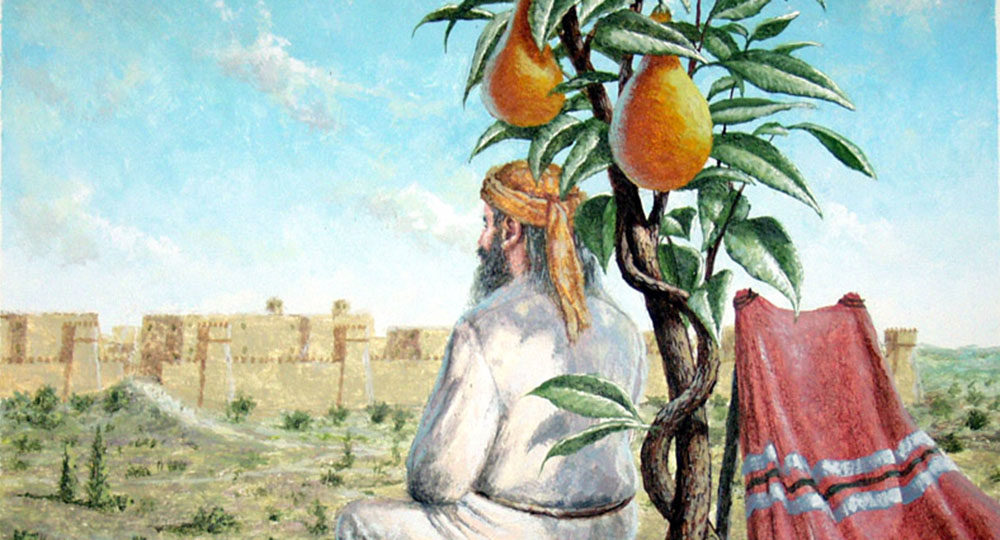
Chapter four tells of Jonah’s anger with God for deciding not to carry out the message of doom upon Nineveh. Jonah encamps outside the city to see what would happen. A gourd-vine grows up, providing shade for Jonah, but is eaten away the following day. A hot east wind and blazing sun make Jonah faint. The Lord is teaching Jonah a lesson, but Jonah will not accept it. Jonah says to God three times he wants to die. The last verses –
But the Lord said:
You are concerned about a vine that you did not plant or take care of, a vine that grew up in one night and died the next. In that city of Nineveh there are more than 120,000 people who cannot tell right from wrong, and many cattle are also there. Don’t you think I should be concerned about that big city? (4:10-11 CEV)
Jonah the prophet knew God’s kindness, mercy, patience and love (4:2), but refused recognition that these could be extended to Nineveh, an enemy of Israel. Jonah’s patriotism deprived him from understanding the universal aspect of God’s being and love. Historically, archaeological digging has revealed Nineveh was sacked in 612 B.C., so if eighth century prophet Jonah of Israel indeed preached there, eliciting a moral change in residents, God withheld punishment of the city for some two-hundred years.
“God must be interpreted anew in each age, and yet remains the same.” “God’s being is suffused with concern, with what A.J. Heschel called ‘the Divine pathos’.”8 God’s got the whole world in his hands.
Notes
- “. . . the complete text measures 689 (or 688) words . . .”; Jack Sasson, Jonah [Anchor Bible 24B] (NY: Doubleday, 1990), p. xi; Sasson is speaking of the Hebrew/MasoreticText
- Siegfried Horn and P. Kyle McCarter, ‘The Divided Monarchy: The Kingdoms of Judah and Israel’ in Hershel Shanks (ed.), Ancient Israel (Washington, D.C.: Biblical Archaeology Society, 1999), p. 160
- See Amos chap. 8
- Jack Lundbom, The Hebrew Prophets: An Introduction (Minneapolis: Fortress, 2010), p. 121
- A date near 400 B.C. seems likely. A good summary of reasons for such a date is given by Jean McGowan; “the satirical tone in which the author writes about the Prophet in the third person suggests that he was not writing about himself,” “the lack of significant details . . . such as the name of the king of Nineveh, suggests that the author was not writing about contemporary events,” “the language of the book is not that of the 8th-cent.”, “the mentality of the author is more like the mentality of the mid-5th cent. Other OT books, such as Ezr, Neh, and Ru, bear witness to the fact that in post-exilic Israel there was a strong current of interest in the question of Israel’s relations to the nations, which would form a natural background for the theme of Jon.”; in ‘Jonah’ in Raymond Brown, Joseph Fitzmyer, Roland Murphy, eds., The Jerome Biblical Commentary (Englewood Cliffs: Prentice-Hall, 1968), p. 633; also, Samuel Sandmel, The Hebrew Scriptures (NY: Oxford, 1978), p. 495f, “The Book of Jonah is considered by modern scholars to come from the latter part of the Persian period (about 375, or possibly even later).”; Buckner Trawick, The Bible as Literature (NY: Barnes and Noble, 1970), p. 301, Jonah had “a strong religious message for the fourth-century rebuilders of Jerusalem”
- That the poem is an insertion or interpolation is held by McGowan, ibid., pp. 633f, 635f and Trawick, ibid., p. 302 (“Chapter 2 is thought to be an editor’s insertion, because it scarcely fits an otherwise well-unified plot.”)
- For different uses of Tarshish in Old Testament, see entry, ‘Tarshish’ by Roger Boraas in Paul Achtemeier, Gen. Ed., Harper’s Bible Dictionary (San Francisco: Harper, 1985), p. 1018; “the Jonah association suggests a location in the Mediterranean, and sites suggested include Tarsus and Tartessus in Spain”
- Both quotes from David Wolpe, The Healer of Shattered Hearts: A Jewish View of God (NY: Penguin, 1990), pp. 8, 72


 Paul's Place for Writing
Well written and researched, as always. Thanks for sharing!
Thanks Jacquie and may God bless you! I ask the Lord always for help in writing and research. There is much to learn in the book of Jonah.
Great post Pauly. You always do such good reseach in all of your post. Be and stay blessed!
Thanks Claudia. May God bless you!